

A Church Engaged in Society
The United Methodist Church: A Church Engaged in Society
Knut Refsdal
How should The United Methodist Church be the Church in a world marked by polarization, fear, authoritarian tendencies, violent rhetoric, xenophobia, and growing nationalism?
Methodism has never been concerned solely with the inner life of faith. From the very beginning of its history, Methodists have insisted that love for God must have concrete consequences for the way we meet our neighbors and for how we contribute to society. Love for God can never be separated from love for other people. This is why, for our church father John Wesley, faith was expressed not only through prayer, worship, and Bible reading, but also through care for the poor, the sick, prisoners, and those pushed to the margins of society. Methodism has therefore always sought to hold together personal conversion and social transformation, personal holiness and social holiness.
The Social Principles serve as constant reminders of this commitment. Over the past year, I have also received further reminders of the importance of this concern on several occasions.
Last year, the bishops of The United Methodist Church published the study and reflection booklet Building Beloved Community: Faithful Responses to Authoritarianism and Christian Nationalism. In August 2026, the World Methodist Council (WMC) focused on many of the same issues during its meeting in El Salvador. The gathering adopted both a pastoral letter that will be distributed throughout the worldwide Methodist family and a comprehensive declaration marking the fortieth anniversary of the World Methodist Social Affirmation adopted in Nairobi in 1986.
Although these documents differ in form and background, they point in the same direction: Methodists are called to be both deeply rooted in Christ and actively engaged in society.
Chosen and Sent
The Church always lives within a tension. It is chosen by God, yet at the same time sent into the world. Therefore, the Church can never become a closed circle primarily concerned with itself. This balance is vital: if the Church forgets God, it loses its power; if the Church forgets the world, it loses its relevance.
This is precisely the tension addressed by the bishops in Building Beloved Community. The booklet seeks to answer the question: How should the Church be the Church in our own time, amid everything we see unfolding around us?
The bishops argue that the Church cannot choose between being a spiritual community and being a people sent into the world. It must be both at the same time. It must be deeply rooted in Christ while also turned toward the world in love, hope, and service.
Christian Nationalism as a Theological Challenge
One of the main themes of Building Beloved Community is nationalism, and particularly what is described as Christian nationalism. Here it is important to distinguish between patriotism and nationalism. Patriotism is love for one’s country. It is natural to value one’s language, culture, history, and people. Christians can thank God for their country, pray for it, and work for its well-being. Nationalism, however, becomes problematic when the nation assumes a place that properly belongs to God. The nation is no longer simply something we cherish; it becomes something in which we place our ultimate trust. Identity is transferred from Christ to the nation. Other people are evaluated primarily according to whether they belong to “us” or “them.”
The bishops describe Christian nationalism as the belief that a nation belongs in a special way to Christians and that national identity and Christian identity should merge. From there, the distance is often short before the gospel is used to legitimize power, exclusion, and fear instead of proclaiming salvation and reconciliation for all people.
For this reason, Christian nationalism is described as a theological challenge, not merely a political one.
Beloved Community
As an alternative, the bishops highlight what Martin Luther King Jr. called the Beloved Community. The idea is simple but radical: the Church has a message about a better way of living together. In a society marked by suspicion, the Church should be characterized by trust. In a society marked by fear, the Church should be characterized by hope. In a society marked by polarization, it should be characterized by reconciliation. In a society marked by exclusion, it should be characterized by hospitality. In this way, the Church becomes a sign of the Kingdom of God.
These, therefore, are the alternatives to Christian nationalism: choosing love rather than fear as the driving force of Christian engagement; building inclusive communities across political, ethnic, and cultural divides; creating space for dialogue and difficult conversations rather than polarization; resisting authoritarian tendencies and working for social healing and justice.
No Holiness but Social Holiness
This way of thinking is deeply rooted in the Methodist tradition. When Building Beloved Community speaks about democracy, human rights, combating racism, and caring for migrants, its purpose is not to turn the Church into a political party. On the contrary, it is about what social holiness looks like in practice.
In the light of Methodist theology, the work of building beloved community is not merely a social project. It is an expression of central elements within our understanding of the Christian faith.
Love as the center of theology: Methodism is deeply rooted in the conviction that God is love. For Wesley, the goal of the Christian life is growth in love for God and neighbor. The Beloved Community is precisely a community in which love finds social and tangible expression. Thus, the building of such a community can be understood as a natural consequence of Methodism’s fundamental understanding of salvation as transformation into love.
“No holiness but social holiness”: This well-known phrase of Wesley emphasizes that discipleship must have consequences for the way people live together, how power is exercised, and how society is organized. This makes beloved community an essential reality. If Christian faith always has a social dimension, then the Church must also work for communities characterized by justice, inclusion, peace, and reconciliation. This is not an addition to the gospel but part of the gospel’s effect in the world.
God’s grace is at work in all people: Methodism places great emphasis on the belief that God, through grace, is at work in all people, even before they come to faith. Therefore, we are concerned with the dignity and God-given worth of every human being. This theology provides a strong foundation for beloved community. If God is already at work in all people, then no one can be dismissed or reduced to an enemy, stranger, or opponent. Rather, the community we seek to realize must be open, inclusive, and marked by respect for the dignity of all.
The connection between personal and social transformation: God does not save only individuals; God also works to renew relationships, societies, and structures. Community among human beings becomes a sign of God’s kingdom, where people learn to live together in new ways characterized by justice, mercy, and mutual responsibility.
The connection between faith and social responsibility: Historically, Methodism has been deeply engaged in issues such as poverty, education, slavery, labor conditions, and human rights. We understand faith as a calling to participate actively in society for the common good. Building beloved community continues this heritage. It is about creating societies in which all people can flourish, where power is shared responsibly, and where the most vulnerable are seen and protected.
A community across boundaries: Methodism is a global and connexional church. It emphasizes that Christians are bound together across national, ethnic, and cultural boundaries. This resonates strongly with Martin Luther King Jr.’s vision of the Beloved Community, where people meet as brothers and sisters in God’s family rather than as members of competing groups. Our fellowship with one another is greater than our national, political, or cultural identities.
The World Methodist Council Continues the Legacy
The meeting of the World Methodist Council in San Salvador this August was likewise concerned with social holiness. Its theme was: “The kingdom of God is righteousness and peace and joy in the Holy Spirit” (Romans 14:17). Representing our Regional Conference were Ingull Grefslie, Thomas Risager, and myself.
The pastoral letter emphasized that faith can never be reduced to private piety. The gospel calls Christians into relationships marked by justice, reconciliation, compassion, and hope. Therefore, the Church must engage with issues such as human dignity, peacebuilding, migration, poverty, ecological sustainability, digital justice, and human rights.
The declaration further describes how the economic, political, technological, ecological, and social challenges of our time are interconnected in what is termed a “polycrisis.” The response is not withdrawal but active participation in God’s work for human flourishing, peace, justice, and reconciliation.
Particularly noteworthy is the emphasis on human dignity. The declaration expresses it this way: “Human dignity is God’s gift. Human rights are humanity’s attempt to protect that gift.”
Here again we find the classic Methodist synthesis of faith and social responsibility.
The World Is Our Parish
Another recurring theme in the documents from the World Methodist Council is Wesley’s well-known statement: “The world is my parish.”
At a time when many challenges transcend national borders, the Council emphasizes the need for international cooperation, peacebuilding, and accountability. No nation can solve the challenges of our age alone. Methodists are therefore encouraged to participate actively in public life, civil society, and democratic processes.
It is noteworthy that the Council gives particular attention to migrants, refugees, and displaced persons. They should not first be understood as political problems or economic categories, but as human beings created in the image of God. The declaration affirms that “all human rights are migrants’ rights.”
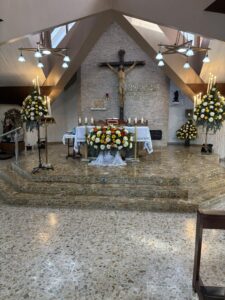
While in San Salvador, we also visited the home of Oscar Romero, the church where he was shot, and the cathedral where he served. Romero was a Catholic archbishop in El Salvador who lived from 1917 to 1980. As Archbishop of San Salvador, he became known for speaking on behalf of the poor and oppressed and for criticizing violence, injustice, and human rights abuses during the country’s political conflict.
On March 24, 1980, Romero was assassinated while celebrating Mass. He has become a symbol of courage, justice, and the struggle for human rights. In 2018 he was canonized by Pope Francis in the Roman Catholic Church.
For obvious reasons, Romero is important to everyone in El Salvador, not only to Catholics. He is also a significant role model for the Methodist Church in the country.
The Methodist Social Affirmation
When the World Methodist Council met in Nairobi in 1986, it adopted a Social Affirmation that remains a concise expression of Methodist social engagement. (This is distinct from what we often refer to as “Our Social Creed,” which belongs to The United Methodist Church and forms part of its Social Principles.) A Norwegian translation may be rendered as follows:
We believe in God, creator of the world and of all people; and in Jesus Christ, incarnate among us, who died and rose again; and in the Holy Spirit, present with us to guide, strengthen, and comfort.
We rejoice in every sign of God's kingdom: in the upholding of human dignity and community; in every expression of love, justice, and reconciliation; in each act of self-giving on behalf of others; in the abundance of God's gifts entrusted to us that all may have enough; in all responsible use of the earth's resources.
We confess our sin, individual and collective, by silence or action: through the violation of human dignity based on race, class, age, sex, nation, or faith; through the exploitation of people because of greed and indifference; through the misuse of power in personal, communal, national, and international life; through the search for security by those military and economic forces that threaten human existence; through the abuse of technology which endangers the earth and all life upon it.
We commit ourselves individually and as a community to the way of Christ; to take up the cross; to seek abundant life for all humanity; to struggle for peace with justice and freedom; to risk ourselves in faith, hope, and love, praying that God's kingdom may come. Thy kingdom come on earth as it is in heaven. Amen.
he Church’s Identity in Our Time
The Church does not exist for its own sake. It exists for the sake of the world. This is the message of both Building Beloved Community and the recently adopted documents of the World Methodist Council. When fear and polarization increase, the temptation is to withdraw and protect our own interests. Methodism, however, chooses to hold fast to this conviction: we are sent out, toward the world, toward our neighbor, toward the stranger, toward the one who suffers, and even toward the one with whom we disagree.
This is what Methodism has always sought to remind us of: God’s grace is personal, but it is never private. It creates disciples who love God and serve the world. That is social holiness. That is Methodist Christianity. And that remains the Church’s calling today.